The Ethiopian Calendar
Also called the Geez calendar, after the classical language of Ethiopian scripture and liturgy, it is Ethiopia’s traditional civil calendar and the liturgical calendar of the Ethiopian Orthodox Tewahedo Church. Its roots lie in the ancient Egyptian and Alexandrian calendar tradition, which the Church inherited and has preserved for centuries. The civil and religious uses are closely connected but not identical: the Church adds its own cycle of feasts, saints’ days, and fasts to the same underlying calendar.
Three features set it apart: a 13-month year, a leap year every four years, and a year count that runs seven to eight years behind the Gregorian calendar.
Structure of the Ethiopian Calendar
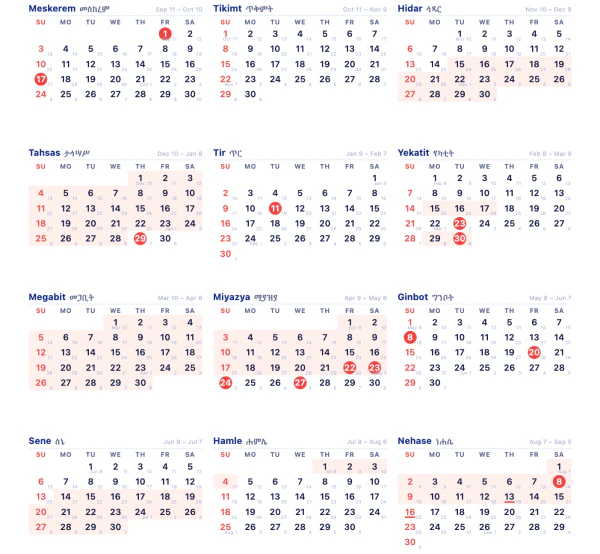
The Ethiopian calendar has 13 months. Twelve have exactly 30 days. The thirteenth, Pagume, is a short intercalary month of five days, or six days in a leap year. The name comes from the Greek epagomenai, meaning “added days.” These extra days complete the year beyond its twelve regular 30-day months.
The year has 365 days, or 366 in a leap year. A leap year comes every fourth year, whenever the year number leaves a remainder of 3 when divided by 4, with no exceptions for century years as in the Gregorian system. The extra day is added at the end of the year as a sixth day of Pagume, not in February. Tradition names each year after one of the four Evangelists (Matthew, Mark, Luke, and John), and the year of Luke is the leap year.
The year runs from Meskerem in September to Pagume in early September. The Gregorian start dates below are typical and can shift by one day depending on the Ethiopian leap-year cycle.
For the leap-year cycle, Bahire Hasab and the calendar’s Egyptian and Coptic roots, see how the Ethiopian calendar works.
This Month: Hidar 2019
Hidar 2019 runs from Tuesday 10 November to Wednesday 9 December 2026.
What Year Is It in Ethiopia?
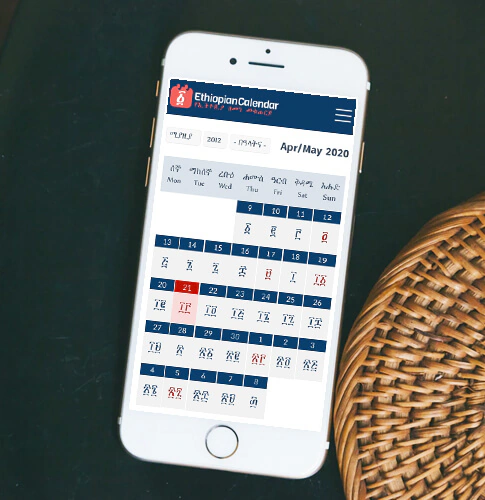
The current year in Ethiopia is 2019 E.C. (Ethiopian Calendar), while much of the world is counting 2026. The Ethiopian calendar year doesn’t turn over on January 1. It changes on Meskerem 1, marking the Ethiopian New Year in September, right after Pagume, the short thirteenth month.